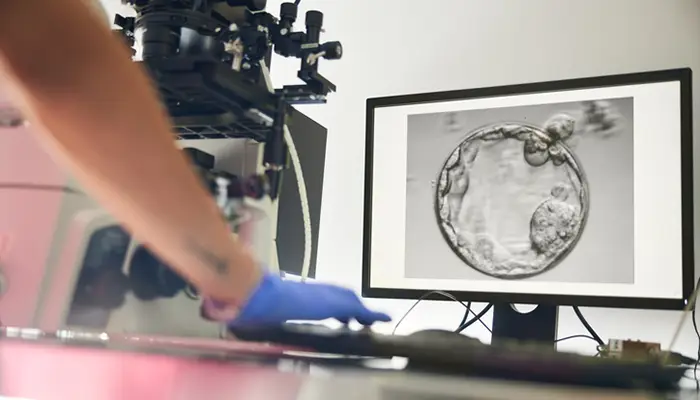
A fertility lab technician performs the fertilization of an egg. – Getty Images
NASHVILLE (BP) – The Ethics & Religious Liberty Commission (ERLC) has released a new practical guide designed to help churches navigate the topic of assisted reproductive technologies (ARTs) such as in vitro fertilization (IVF).
The free guide, released Tuesday (Feb. 24), is titled “Desiring Children: A Practical Guide to Addressing Assisted Reproductive Technologies in the Church.”
It contains a theological framework addressing the topic of ARTs from a biblical worldview and offers answers to practical scenarios that ministry leaders may face or have faced regarding the topic. The guide also contains a list of additional resources on ARTs from a variety of Christian sources.
The guide was written by the ERLC research team, led by RaShan Frost, ERLC director of research and senior fellow.
“The desire to have children of one’s own is a good and natural desire that recognizes the gift sons and daughters are to our families and our societies. Unfortunately, due to the fall in Genesis 3, the desire to have children is often complicated by the devastating reality of infertility,” Frost wrote in the guide’s forward.
“Today, many couples struggling with infertility are able to have children through the use of assisted reproductive technologies (ARTs). The realities of ARTs, such as intrauterine insemination (IUI), in vitro fertilization (IVF), surrogacy, and embryo adoption, have created ethical questions that Christians must consider.”
The topic of ARTs has been a recent discussion point within the SBC, as messengers to the 2024 Southern Baptist Convention approved a resolution titled “On the Ethical Realities of Reproductive Technologies and the Dignity of the Human Embryo.”
Jason Thacker, director of the ERLC’s research institute and senior fellow for life and other bioethical issues, served as the ERLC liaison on the 2024 SBC Committee on Resolutions. The full resolution is included as an appendix in the guide.
The resolution does not condemn ARTs outright, acknowledging that all children (including those conceived via ARTs) are a blessing made in the image of God, but it also acknowledges some of the ethical concerns and questions that the use of ARTs can raise. These concerns and questions are what the guide seeks to help churches navigate.
“The view that ARTs can be a gift to solve the pain of infertility is one that many people, Christians included, have taken and acted upon to fulfill the dream of having children,” Frost said.
“However, while these technologies are available, the ethical implications of ARTs raise many concerns that we ought to evaluate before utilizing or recommending them to others. The question that ARTs present for us as Christians is: Are we to pursue having children by whatever means possible?
“We all must slow down to consider how biomedical technologies like ARTs shape our view of the world around us. Discussions about the use of ARTs are difficult but also vitally important work, especially for church leaders who are seeking to care for and support couples struggling with infertility.”
The points that make up the guide’s theological framework are:
- Infertility is a widespread and devastating reality for many couples, and the Church must be prepared to engage in these realities with truth, love and grace.
- Every human being is made in the image of God and has intrinsic dignity – no matter their stage of development, location, or the circumstances of their conception.
- The marital bond between man and woman is sacred, and procreation is designed to take place within the covenantal relationship of marriage.
- Children are a blessing from God, not commodities simply to be made.
- God is sovereign over the procreative process, and His good design for humanity is to be fruitful and multiply.
- Technology can be used in ways that express people’s God-given dominion over creation, but it also shapes their perceptions of the world, including procreation.
Some practical scenarios addressed in the guide include:
- A couple in your church has long struggled with infertility and are seriously considering beginning the IVF process. How do you counsel them through this decision?
- A husband and wife in your congregation have always desired children but have never been able to get pregnant on their own. Amid their infertility journey, they recently learned about embryo adoption and have wondered if it is right for their family and about the ethics of such an adoption.
- You seek to counsel a couple through traditional adoption as an alternative option instead of ARTs.
- A couple comes to you wondering what they should do with their remaining embryos after using IVF to successfully have a child.
- A couple is considering various forms of surrogacy to pursue having a child.
Frost reiterated that the ultimate goal of the guide is to serve Southern Baptists.
“As we engage issues of bioethics centered on the sanctity of life, the complexities of this subject require theologically and biblically grounded ethical responses coupled with compassionate pastoral care,” Frost said.
“The goal is to help local churches, pastors, ministry leaders, and other Christians navigate the heart-wrenching difficulties of infertility in light of the technologies available to couples who desire to have children. We pray that the guide will help our churches think through the ethics of ARTs, shepherd and care for families affected by infertility, and respond lovingly with the hope of the Gospel.”
This story was originally published by Baptist Press.