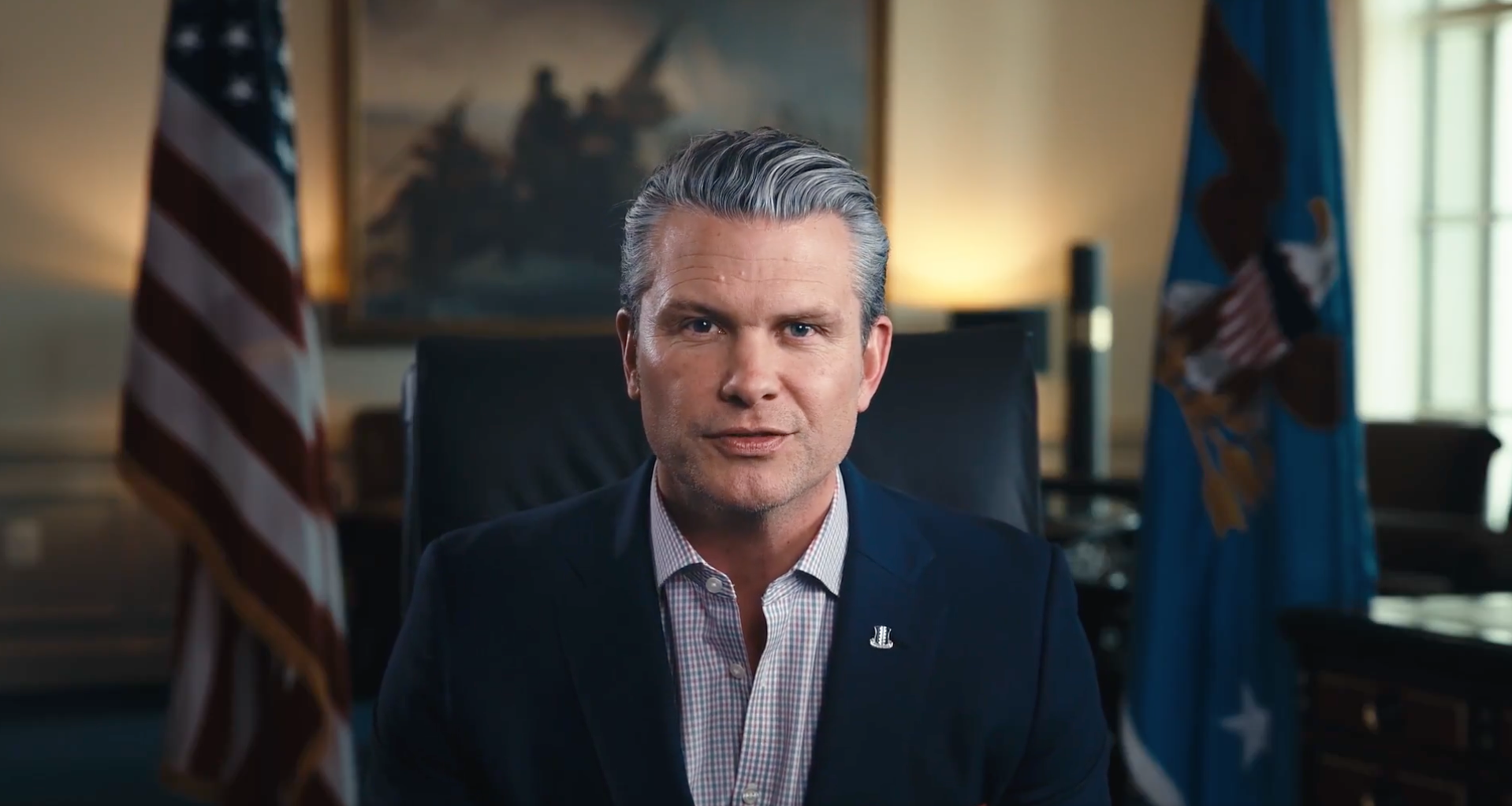
Secretary of War Pete Hegseth announced changes to the military chaplaincy corps in a Tuesday, March 24, video announcement on social media. – BP / Screen capture
WASHINGTON, D.C. – Secretary of War Pete Hegseth announced two historic changes to the military’s chaplaincy corps this week after previewing those updates in December of last year.
The first was the consolidation of the faith codes associated with chaplaincy and the second was the replacement of rank insignia from chaplains’ uniforms with their religious insignia.
“A chaplain is first and foremost a chaplain and an officer second. This change is a visual representation of that fact,” Hegseth said in a video announcing the changes.
While they will continue to maintain their rank, Hegseth said removing the visual sign of rank will help them “be seen among the highest ranks because of their divine calling. This reform is intended to uplift and celebrate the chaplain’s role as a chaplain.”
From chaplaincy’s inception to in 1775 until 1914, chaplains served without rank or rank insignia, said North American Mission Board executive director Doug Carver. In 1914, they were authorized to wear their rank, starting out as first lieutenants in the Army.
“This policy change emphasized the functional role of a military chaplain as a pastor in uniform as a commissioned officer,” said Carver, a retired military chaplain who served as 22nd Chief of Chaplains for the U.S. Army, earning the rank of Major General.
Hegseth said removing the insignia will help enlisted service members and junior officers feel freer to seek the counsel of chaplains, potentially removing any sense of intimidation they may feel in talking about their personal lives with someone of higher rank.
Carver noted that this is not the first time the rank insignia has been removed as General John Pershing directed chaplains to remove it during World War I. Carver said Pershing similarly believed “that soldiers would have less ‘reticence’ about talking to a chaplain who wore no rank.”
A 1926 War Department policy change again put rank insignia back on chaplain uniforms. That same year, Congress passed legislation guaranteeing, for the first time, that chaplains would be given the rank, pay, and allowances that accompanied their grade.
“From 1926 to 2026, chaplains have visibly, and humbly, worn the insignia of rank on their uniform,” Carver said.
Hegseth, in his announcement, emphasized the importance of spiritual health for members of the U.S. Armed Services and shared his belief that these changes underscore that importance.
“The military’s chaplain corps serves as the spiritual and moral backbone of our nation’s armed forces,” Hegseth said. “Chaplains help forge spiritual readiness across the force, and that matters because, in combat, in crisis, and in loss, a war fighter needs more than a coping mechanism. They need truth, ‘big T’ truth. They need conviction. They need a shepherd.”
For Baptist military chaplains, Carver said, the recent updates from the Department of War do not change their calling to the military chaplaincy. Chaplains still have the freedom and access to share the Gospel with members of the Armed Services and their families.
“Military chaplaincy is a unique ministry calling, and that calling is recognized and commissioned by the local church,” said Carver. “And chaplains will continue to hold rank for administrative purposes (for example: pay, promotion, etc.), and they will continue to focus on taking the gospel to members of the Armed Services and their families.”
The decision to reduce the number of religious affiliation codes from more than 200 to 31 was an administrative action designed to streamline the Chaplain Corps and align it with what Hegseth termed its “original purpose.” It will simplify and clarify the role of chaplains and remove excess codes that often went unused.
The Department of War’s new policy underscores the military chaplain’s institutional tension, fully and faithfully meeting the needs of both the church and the Armed Services. Military chaplains will continue in their functional roles as pastors in uniform and as commissioned officers.
“Please pray for our Southern Baptist chaplains as they adapt to changes while, at the same time, serving the needs of our deployed troops engaged in armed conflict,” Carver said.
Note: Story published by Baptist Press. Brandon Elrod writes for the North American Mission Board.