Note: Professor Marshall King was leading a group of students on an archaeological dig in Israel when the U.S. and Israel carried out strikes on Iran.
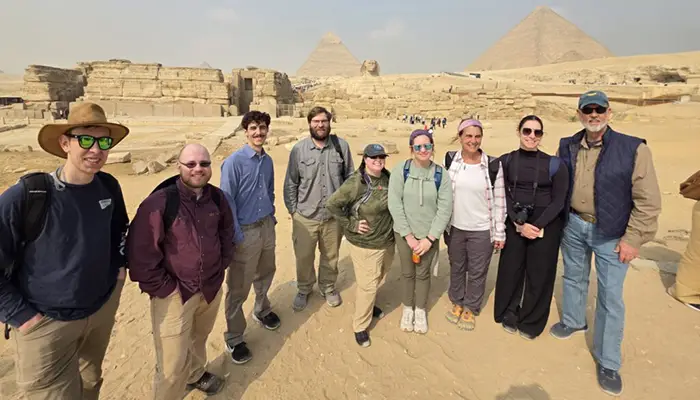
A group of Carson-Newman University visit Egypt after their planned archaeology dig in Israel was canceled due to war. – Baptist Press Photo
There is a moment in archaeological fieldwork that experienced diggers learn to anticipate and novices never forget. You have been moving through unremarkable soil for hours, sometimes days: careful, methodical, patient in the way the work demands. And then the character of the dirt changes. Your trowel meets a different kind of resistance. The dirt’s color shifts. You call your colleagues over and begin to work more slowly, because you have reached, in this instance, the collapse layer: the stratum where an ancient structure once above you fell in on itself, where the roof came down and the walls followed and the whole ordered world of whoever built this place surrendered to the pressures of time.
The rule of thumb in this moment is counterintuitive to anyone who has not dug before. The collapse looks like the end of the story. It usually isn’t. It is the threshold. Because the collapse sealed the layers beneath it, preserved them, held them in a kind of suspended animation against the intrusions of later centuries. The best material—the pottery, the coins, the objects that tell you who these people were and how they lived—is very often beneath the collapse waiting for discovery. Destruction, it turns out, is one of the primary mechanisms of preservation, and as archaeologists, you have to go through the rubble to reach the treasure.
As a professor at Carson-Newman I have taught this principle to students for years. In the Judean wilderness in February of 2026, God taught it back to me.
Hyrcania is not a famous site – yet. It does not draw the tour buses that crowd Masada or the pilgrims who queue at the Church of the Holy Sepulchre. It is a Hasmonean fortress on a hill southeast of Jerusalem, commanding a long view of the desert that runs toward the Dead Sea. Herod knew it and enlarged it. John the Baptist may have been held prisoner there. We know that Herod’s son Antipater was executed there, a mere four days before his paranoid father died from what was likely sepsis. After the dust settled in the wars between Judea and Rome, Christian pilgrims from the Mar Saba monastery took up residence in the ruins, turning it into a monastery for the faithful. Sometime after the Islamic conquest, in the intervening centuries, Hyrcania had sat in relative silence, its stones settling quietly into the hillside, waiting.
On the morning of Feb. 26, my students and I climbed that hill. The Judean air was cold and clear in the way it only is in winter with a sharpness that feels invigorating, as if the landscape itself is breathing life into you. Storm clouds were off in the distance hanging over the Mountain of the Scapegoat. In the opposite direction, the Dead Sea shimmered like a sheet of copper in the distance with the Plains of Moab flanking from behind. Our team of nine took our positions on the slope and began to dig.
By midday we had reached it: the collapse layer. I watched their faces change as we explained what it meant that the rubble beneath their trowels was an announcement, not an obstacle. That ancient ruins had to fall for their secrets to be kept. That the destruction they were looking at was the very thing that made the discovery possible. They leaned closer. They began to work more carefully. They understood, the way you only understand a thing when your hands are in it, that the best was yet to come.
The following day was Friday, and the Israelis do not excavate on Friday or Saturday. So we journeyed to Herod’s unrivaled citadel of Masada, to Qumran’s scroll-keeping cliffs, to the shore of the Dead Sea where the students floated on their backs in the ancient water of Arabah and laughed at the strangeness of a world that contains such an alien place. They were, by every account, lifted by the experience. The trip was everything it was supposed to be, more than we had hoped for.
We did not know, driving back to Jerusalem that Friday evening, that we were about to hit our own collapse layer.
On Saturday morning, Feb. 28, en route to the Galilee and a mere few minutes from parking, every phone in both of our vehicles began to scream simultaneously. Sirens rose from the Judean hills. We pulled to the side of the road, followed the guidance of our guide, and waited. The sirens, we learned, were not warning of an incoming strike – not yet. They were sounding because Israel and the United States had struck Tehran, and the warning was to prepare us for retaliation.
We turned the cars around and made it back to our hotel, the Olive Tree in Jerusalem before the first barrage of missiles arrived. With them, the dig was over. The itinerary was over. Airspace was closing around us: the exit through Amman was shut while I was still on the phone with the airline. The carefully planned archaeological season had come down, suddenly and completely, like an ancient roof collapsing in on itself.
The sirens would sound more than 40 times in the next 48 hours. Each time, we descended to the subterranean third floor of the hotel’s bomb shelter and waited together in the concrete quiet. Our room was called, “Jericho,” – a place not known for its history of strong walls. And it was there, in that rubble of a ruined trip tucked into the Jericho Room of the bomb shelter of the Olive Tree hotel in Jerusalem, that I stopped being an archaeologist and remembered I was also a pastor.
I am both of those things. I am a faculty member at Carson-Newman University and a Baptist minister, and in most seasons of life those two callings run alongside each other like two winding streams that intersect at various points. The scholar wants to analyze; the pastor wants to tend. The scholar wants to understand the past; the pastor wants to be present in the now. In the shelter beneath the Olive Tree, there was no tension at all. Only one of those callings was needed because only one of those callings can address the most pressing questions of the frightened human heart.
We prayed, and we took comfort in our Christian fellowship. We played cards. We told stories in the dark. I sat with students who were carrying a weight they had never carried before: real fear, adult fear, the kind that does not resolve with empty reassurance, and I did the only thing a pastor can do in that situation. I stayed with them as a shepherd protecting a flock terrified by the danger all around.
I did not have answers about when the airspace would reopen or what the geopolitical calculus would produce. I had presence, which is, when you strip everything else away, the central pastoral gift. It is also, I realized in those hours, a pale reflection of the central theological claim of the Christian faith: that God did not observe our collapse from a safe distance but entered it that he might extract us from the doom that had befallen us.
The Olive Tree Hotel, in those hours, became something Jerusalem has always been across its long and layered history, a place where frightened people gather in sanctuary. The lobby filled with stranded travelers: Americans, British visitors, church groups from South Korea, tour parties, an elected official from North Carolina sitting with his tearful and terrified teenage daughter, his face carrying the heartbreaking expression of a parent who cannot protect his child and knows it. Different nations, different traditions, different reasons for being in the Holy City. All of them underground together, moving toward each other in the way that people do when the distinctions that ordinarily separate them stop seeming important.
I do not want to sentimentalize what was, genuinely, a frightening situation. But I also cannot be dishonest about what I saw forming in that shelter: something that looked, in its improvisational and unrepeatable way, like the church. The church being the place of refuge for those taking the bombardments of a fallen world.
Through a series of connections that I could spend another essay describing – and which I believe we can only attribute to grace – we secured passage out on Monday morning, March 2. A convoy organized through a Jerusalem-based Christian tour operator carried our group south through the Negev, past Eilat, and across the Begin Crossing at Taba into Egypt, where we joined a group led by Pastor Ed Litton.
We took the dusty and lonely road through the Sinai, along the Gulf of Aqaba, arriving at the oasis of peace, Sharm el-Sheikh, on the shore of the Red Sea. For the first time in many days, I saw the stress melt from my students as they waded into the Red Sea. I watched them from the beach. These were the same young men and women who had been underground 48 hours before, sitting with fear entombed in a concrete shelter. Now they were laughing and floating in the most storied body of water in the entire sweep of redemptive history. The sea that parted. The sea that the children of Israel crossed on dry ground in their own exodus.
It wasn’t lost on us that God had given us an exodus too, but here an escape from danger in the protection of Egypt. That salvific direction is attested in Scripture too. My mind went to Moses, whose mother placed him in a cataract of the Nile, floating from the Goshen region down to the great capital of Memphis, preserving his life and ultimately the life of his people. Some 1,500 years later, the angel would visit Joseph to warn him of Herod’s plan to murder the infants, ordering him to take Mary and Jesus to Egypt for safety. Here we were. Safe in Egypt because of God’s power and providence.
We departed Sharm for Cairo on Tuesday; the students stood before the pyramids. They walked the halls of the Grand Egyptian Museum. Their faces had the particular brightness of people who have come through something and arrived, unexpectedly, at wonder. Our guide, when hearing of our odyssey spoke prophetically, “God’s plans are better than our plans.” Those were the words that took the deepest root in my heart.
The trip that had collapsed was not, it turned out, finished. Beneath the rubble of the original itinerary was something that could not have been planned: the Red Sea at sunset, the pyramids at morning, a group of young people who had learned, in the most unambiguous possible way, that their faith was not a theory; it was a shield and a reward.
The best material was beneath the collapse. Of course it was. It always is.
I think, since returning, about the students who reached that collapse layer at Hyrcania – the moment when their patiches and trowels met the rubble of the fallen fortress and I explained the rule. They leaned in. They understood. They began to work more carefully.
I think about the people reading this who are in their own collapse layer right now – a marriage, a vocation, a season of faith that has come down around them like a unbearable roof. The rubble looks like the end of the story. I want to say, as carefully and as honestly as I can: it is not. It is the threshold. The destruction is the preservation. The collapse is the condition for what lies beneath it.
You have to go through the rubble to reach the treasure. Every archaeologist knows this. So does every theologian worth his salt. The question is whether we believe it when we are the ones holding the trowel.
Story originally published by Baptist Press.